AL
AL
 EN
EN
 IT
IT
 ES
ES
 DE
DE
 RU
RU
 EL
EL
 PL
PL
 CS
CS


 Information
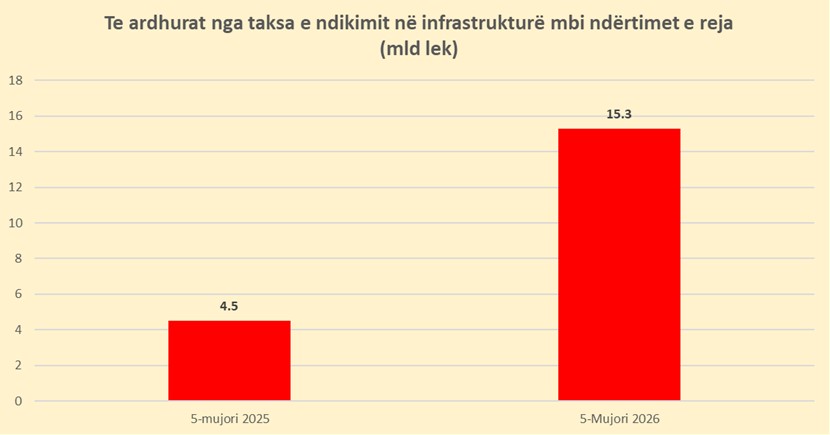
Infrastructure Impact Tax Reaches a Record Level in Just Five Months Albania’s construction sector continues to maintain strong momentum, while the latest data from the Ministry of Finance show that ALL 15.3 billion was collected from the infrastructure impact tax during the first five months of 2026. Compared to the same period in 2025, this represents a 240% increase, marking the highest level of revenue ever recorded from this tax. Moreover, this figure is already close to the 2024 record, when approximately ALL 18 billion was collected throughout the entire year, indicating that 2026 could set a new all-time record. The infrastructure impact tax is paid only when new construction projects are approved and developed. Therefore, its growth is a direct indicator that activity in the construction sector remains exceptionally strong. At the same time, the total area of building permits approved between January and May is estimated at around 2 million square meters, signaling that in the coming years the market will be supplied with a significant number of apartments, residential complexes, tourism facilities, and other development projects. This suggests that developers continue investing in new projects, while demand for urban and tourism development remains robust. Revenue from this tax not only reflects the performance of the construction sector but has also become an important source of funding for public institutions. According to official data: Around 31% of the increase in central government budget revenues during the first five months came from this tax. For local governments, infrastructure impact tax revenue accounted for 87% of additional revenues. It also represented approximately 54% of municipalities' own-source revenues. These figures demonstrate that the construction sector continues to play a significant role not only in the economy but also in financing public investments and local services. Although rising revenues are positive for public finances, experts emphasize that heavy reliance on this tax also creates a high level of dependency. Unlike property tax, which provides stable annual revenue, the infrastructure impact tax is paid only during the development of new construction projects. If the pace of building permit approvals slows or demand for real estate declines, revenue from this tax could also decrease significantly. For this reason, economists believe that budget revenue growth should also be supported by other sectors such as manufacturing, services, and exports. Recent meetings of the National Council of Territory and Water have reviewed hundreds of applications for building permits, including residential, tourism, energy, and infrastructure projects. If this pace continues, the construction sector is expected to remain one of the main drivers of Albania's economy throughout 2026. This means more investment, more projects under development, and a larger supply of properties entering the market—factors that will directly influence the future performance of Albania's real estate market.What Does This Mean for the Real Estate Market?
An Important Source of Revenue for the Government and Municipalities
Is There Also a Risk?
What Is Expected in the Coming Months?